
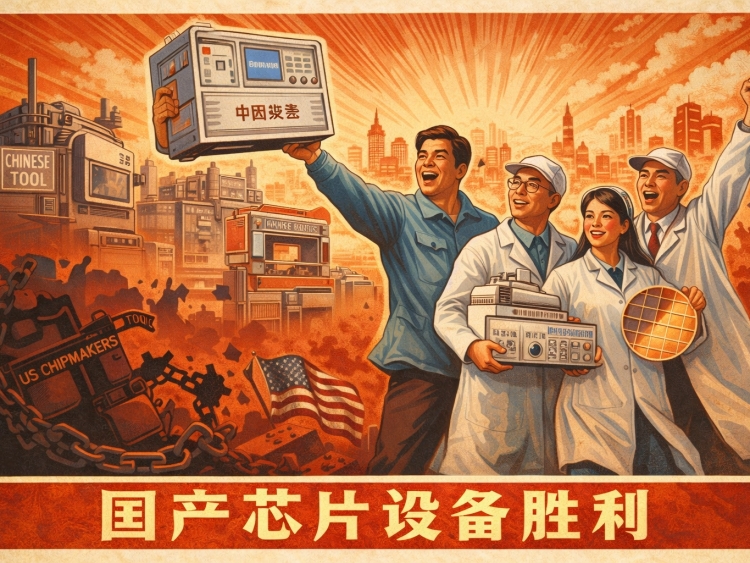
The rule is not publicly documented, but fabs seeking state approval have been told to prove through procurement tenders that at least half the tools will be Chinese-made.
Reuters said the mandate is one of Beijing’s most significant moves to kick its reliance on foreign tech, a push that accelerated after US export curbs tightened in 2023. Those restrictions blocked some leading-edge gear, but the new 50 per cent threshold is pushing fabs to pick Chinese suppliers even where US, Japanese, South Korean and European kit is still available.
Applications that miss the mark are typically rejected, though authorities reportedly show some flexibility when supply is tight. The demands are also relaxed for advanced production lines where domestic tools are still not fully ready.
One source told Reuters, “Authorities prefer it to be much higher than 50 per cent.. Eventually they are aiming for the plants to use 100% domestic equipment,” he said.
China’s industry ministry did not respond to Reuters’ request for comment, and the sources kept their identities anonymous because the measure is not public.
Chinese President Xi Jinping has called for a “whole nation” effort to build a self-sufficient chip supply chain, dragging thousands of engineers and scientists into the project. Reuters also reported earlier this month that Chinese scientists are working on a prototype tool for cutting-edge chips, a result that Washington has spent years trying to prevent.
A former Naura Technology employee said, “Before, domestic fabs like SMIC would prefer U.S. equipment and would not really give Chinese firms a chance. But that changed starting with the 2023 U.S export restrictions, when Chinese fabs had no choice but to work with domestic suppliers."
State-affiliated buyers placed a record 421 orders for domestic lithography machines and parts this year, worth around 850 million yuan (€103 million), according to procurement data cited by Reuters. Beijing has poured hundreds of billions of yuan into chips via the “Big Fund”, which set up a third phase in 2024 with 344 billion yuan ($49 billion) in capital, or about €41.8 billion.
European Central Bank
The policy is already shaping winners and losers, including in etching, the crucial step where material is stripped from silicon to carve transistor patterns. Reuters said China’s largest equipment group, Naura, is testing etching tools on SMIC’s 7nm (nanometre) line, after earlier deploying tools on 14nm.
One of the people told Reuters, “Naura’s etching results have been accelerated by the government requiring fabs to use at least 50 per cent domestic equipment,” adding it is forcing suppliers to improve fast.
Advanced etching tools were previously dominated in China by foreign firms such as Lam Research and Tokyo Electron, but are now being partially replaced by Naura and smaller rival Advanced Micro-Fabrication Equipment (AMEC), sources told Reuters. Naura is also supplying Chinese memory makers with etching tools for chips with more than 300 layers, and developed electrostatic chucks to replace worn parts in Lam kit that could not be serviced after the 2023 restrictions.
Global rivals are watching China’s progress with the kind of enthusiasm you reserve for a tax audit, as foreign suppliers get squeezed out. Reuters said Naura filed a record 779 patents in 2025, more than double its 2020 and 2021 totals, while AMEC filed 259.
Naura’s first-half 2025 revenue jumped 30 per cent to 16 billion yuan (€1.95 billion), while AMEC reported a 44 per cent jump to five billion yuan (€608 million).
European Central Bank
Analysts told Reuters that China is now roughly 50 per cent self-sufficient in photoresist-removal and cleaning equipment, once dominated by Japanese firms but now locally led by Naura.
Another source said, “Two to three major manufacturers will dominate the domestic equipment market, and Naura is definitely one of them.”